Your Brain on Coaching
ADHD Coaching, Neurology, ACT
Your Brain on Coaching: Why “Just Try Harder” Never Works for ADHD
If you're a clinician with ADHD, you've probably had this exact experience: you know the intervention. You could teach it in your sleep. And yet you still can't get yourself to start the note, return the call, or leave the house on time. That gap between competence and execution gets read as a character flaw more often than it gets read as neurology. The research on coaching suggests it's the second one.
The theory: Intentional Change Theory (ICT)
Most of the modern research on why coaching works, rather than just that is works, traces back to Richard Boyatzis's Intentional Change Theory (ICT). The core claim of ICT is that sustained, desired change is driven by a person's ideal self and personal vision rather than by external pressure to fix a deficit. Engaging a person's ideal self is treated as an essential driver of sustained, desired change. Vision-first coaching isn't just a nicer style; rather, it's doing something functionally different in the brain than deficit-first coaching.
Two ways to coach, two different nervous systems
Boyatzis and cognitive neuroscientist Anthony Jack ran fMRI studies comparing two coaching approaches:
Coaching to the Positive Emotional Attractor (PEA) by asking someone to describe their hoped-for future, their values, what a good life looks like to them.
Coaching to the Negative Emotional Attractor (NEA) using the more conventional approach, focused on gaps, weaknesses, and external standards of success.
PEA coaching emphasizes compassion for a person's hopes and dreams and has been shown to produce lasting behavioral change, while NEA coaching, which zeroes in on external benchmarks and personal weaknesses, does not produce change that sticks. On the physiology side, the researchers found PEA coaching was associated with broader visual processing and engagement of the parasympathetic nervous system (the "rest and digest" system), while NEA coaching engaged the sympathetic nervous system (the stress response).
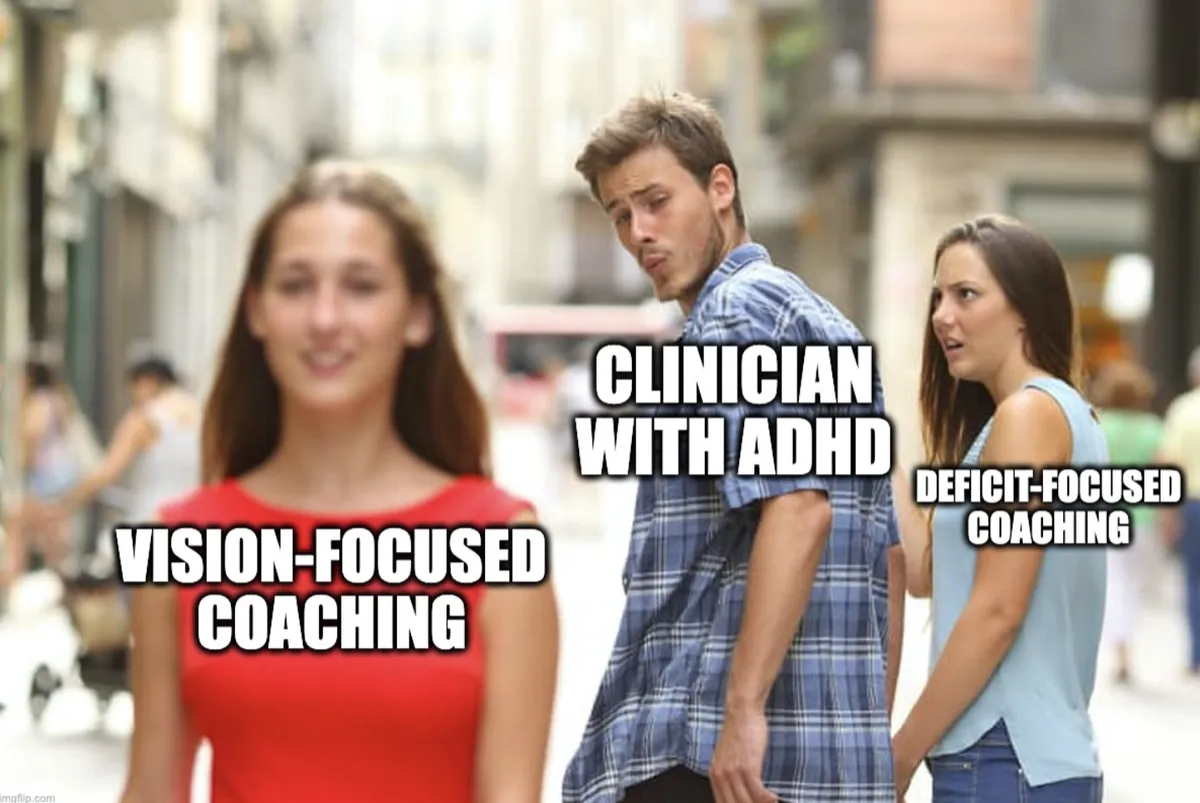
For clinicians with ADHD, this maps almost too neatly onto lived experience. Have you ever wondered why receiving feedback is so difficult? Every performance review, supervision session, every "why can't you just...," every well-meaning supervisor pointing out what you're not doing is NEA coaching, and it's activating the same threat physiology as any other stressor. It's not that the feedback is wrong. It's that the delivery mode itself is working against change.

The networks doing the work: DMN vs. task-positive network
This is where it gets specific to brain networks you may have heard of in other context. The vision- and compassion-focused coaching activated the default mode network (DMN), which is the network associated with motivation, positive emotion, social connection, openness to new ideas, increased visual thinking, and creativity. The deficit- and compliance-focused coaching instead activated the task-positive network (TPN), associated with detailed problem-solving, but also with stress, avoidance motivation, and self-consciousness.
The DMN and TPN behave like a seesaw. First, the DMN is suppressed during externally focused tasks and comes online during rest, mind-wandering, imagining the future, and social reasoning, and it shows an anticorrelated relationship with the fronto-parietal task-positive network. This is worth taking a pause to consider, because DMN dynamics are a live area of interest in ADHD research generally. In fact, atypical DMN regulation is one of the more replicated findings in ADHD neuroimaging (worth it's own blog post). Coaching that works with the DMN rather then constantly yanking someone into task-positive threat-mode may be doing something particularly well-suited to an ADHD brain.
How we know: the imaging tools behind the claims
Two technologies show up in this research, and they're worth distinguishing:
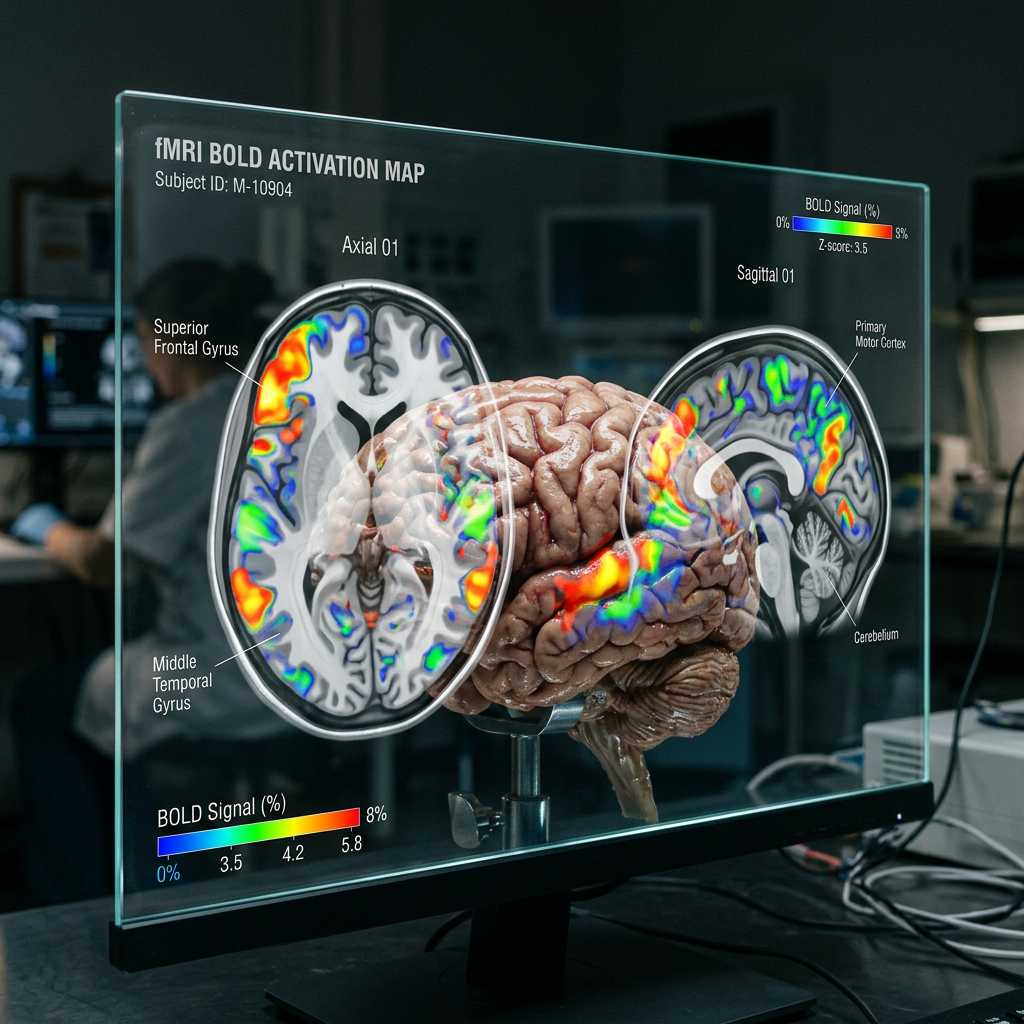
fMRI (functional MRI) is what the Boyatzis/Jack coaching studies used. It tracks blood-oxygen-level changes (BOLD signal) to infer which brain regions are more active moment to moment. It's the tool behind essentially all of the PEA/NEA/DMN coaching findings above.
fNIRS (functional near-infrared spectroscopy) is a newer, more portable alternative. It uses infrared light to measure oxygenated and deoxygenated hemoglobin concentrations as a proxy for neural activity, and it's increasingly used for prefrontal cortext research specifically. Early neurofeedback studies show people can learn to volitionally increase activity in the dorsolateral prefrontal cortex, a region central to working memory.
Back in 2015, during my doctoral studies, I had the tremendous opportunity to work along-side Dr. Richard Lamb in the Neurocognition Science Laboratory at SUNY University at Buffalo. At the time, we were primarily focused on using the fNIR to look at what happens in the brain when "learning" is occurring; however, that research did not take into account the receipt of feedback, corrective or otherwise. That would have been an interesting extension (someone tag Rich Lamb).
Also, short, semi-funny story: I got to try out the fNIR in the lab during a very basic working memory task. My brain was lit up like a Christmas tree - super bright in many spots, but dark in others. I was asked whether I had severe anxiety, which I do not. The funny part of looking at the image of my Christmas-tree brain is that what I was seeing was actually ADHD (hyperactivity mixed with hypoactivity). I should have known something was up then, but I just chalked it up to being super excited to work in the lab.
Does ADHD coaching itself hold up?
Separately from the mechanism research, there's now a real (if young) outcomes literature specifically on ADHD coaching. Roughly 20 studies on ADHD coaching outcomes, including three randomized controlled trials, show evidence of improvement in executive functioning and, in some cases, ADHD symptoms, functional impairment, and well-being along with gains that hold up over time and associated the high client satisfaction. A recent prospective study of adults found statistically significant improvements with medium to large effect sizes on validated measures of ADHD symptoms, executive functioning, and functional impairment after a coaching engagement (this study is not yet published, but I will be reviewing it in a future blog post when it is).
The honest caveat, which is worth including for a clinician audience: most of this research has been done with college students (sampling bias), and adult samples remain comparatively small, so "well-established" would overstate it. "Growing and consistently positive" is the more accurate frame.
Where this leaves us
Put together, the research says something clinically useful and personally validating at once: coaching that starts from values and vision engages different brain systems than coaching that starts from deficits; and only the former reliably produces change that lasts. For clinicians who've spent years being coached (or coaching themselves) from a deficit frame, that's not just a nice reframe, it's a path to trying something different that could actually produce change.